Meme coin entry strategy
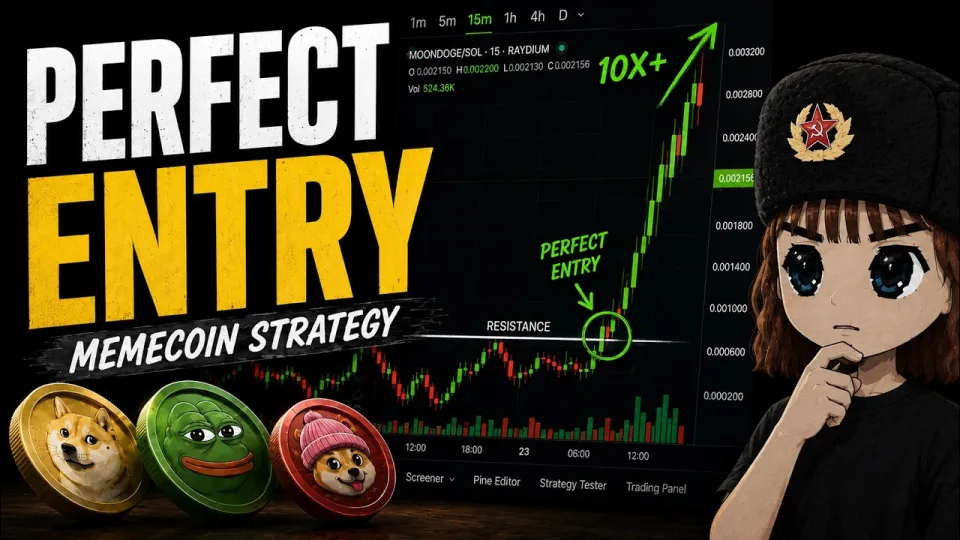
Video: How I Find the PERFECT Entry on Memecoins 📈 (Full Strategy)
Need articles like this for your video? They help promote it on YouTube and Google — order them in the Telegram bot @sat_sit_bot. It writes articles around your video, embeds the video and publishes them on popular niche websites (no ads). Your first 50 articles are free.
· based on the channel starwifpump
Key takeaways
- Most meme coin losses come from timing, not from picking the wrong token — the entry defines your risk-to-reward.
- A valid setup needs three confirmations: momentum, a pullback to support, and a clear invalidation level.
- Chasing green candles and buying on FOMO is the single most common way traders destroy their average entry.
- Risk, exit targets and profit-taking are planned before the trade, not after the price moves.
- Red flags that cancel an entry: vertical unbroken candles, thin liquidity, and no defined level to lean on.
A meme coin is a highly volatile token whose price is driven mostly by attention and liquidity rather than fundamentals, so the entry point matters more than the pick itself. The practical answer is to wait for a setup with three confirmations — momentum, a pullback to a support level, and a clear invalidation point — and to size the position before you click buy. Traders who want live chart examples and tooling for this workflow can start in the Plasma Telegram channel, where the author of the breakdown shares early access and setup help.
Why the entry decides the outcome of a meme coin trade
A good token bought at the wrong moment turns into a bad trade, and the arithmetic is brutal. If you buy the top of a vertical candle, your stop has to sit far below, which means either a huge position risk or a stop so tight that normal volatility knocks you out. Buying a pullback to a level lets you place the stop just under that level, so the same dollar risk buys a much larger move.
This is the core idea behind the strategy breakdown published by the starwifpump channel: the goal is not to predict every move, but to build a repeatable process that replaces emotional buying with a checklist. The channel's framing is direct — most meme coin traders do not lose because they chose the wrong coin, they lose because they entered at the wrong time.
The three confirmations before any entry
A quality entry on a meme coin is a stack of confirmations, not a single signal. Skipping any one of them is what turns a trade into a gamble.
- Momentum is real, not a single wick. Volume and higher highs should confirm that buyers are actually present, not that one large order printed a candle.
- Price has pulled back into a level. Support can be a prior consolidation range, a breakout retest, or a moving average that has held more than once.
- There is a clean invalidation. You can point to the exact price where your idea is wrong, and that price is close enough to make the risk acceptable.
If you cannot name all three in one sentence, the setup is not ready. Patience here is not a personality trait — it is the filter that removes most low-quality trades.
How to read momentum without chasing the pump
Momentum tells you whether a move has fuel; chasing tells you whether you are late. The distinction is timing relative to structure, not the size of the candle.
A healthy momentum read looks like expanding volume on up-moves, shallow red candles on the pullback, and buyers stepping in at the same level repeatedly. A dangerous read is a vertical run with no pause, thin liquidity, and candles that keep gapping — there is no structure to place a stop against, so the only possible entry is a guess.
Practical rule: if the token is already up several multiples from its base and has not retested anything, you are not early, you are exit liquidity. Wait for the first real pullback or skip the trade entirely.
Pullbacks, support and the levels worth waiting for
Support is where your risk becomes measurable, which is why pullback entries beat breakout entries for most retail traders on meme coins. Three level types are worth watching:
- The breakout retest. Price breaks a range, comes back to the top of that range, and holds. The old resistance becomes the new floor, and your stop sits just beneath it.
- The consolidation shelf. A token chops sideways for a while, builds a base, and then expands. The top of the base is the level to defend.
- The repeated reaction level. A price that has produced two or three visible bounces is a level other traders are watching too, which makes it self-reinforcing.
On Solana meme coins these levels form and break fast, often within minutes, so the entry has to be planned in advance rather than improvised on the chart.
Signals that tell you not to enter
Knowing when to stand aside is half of the strategy, and the red flags are consistent across meme coin charts.
- Price is vertical with no pullback and no base — nothing to lean a stop against.
- Volume is fading while price grinds higher, a classic divergence before a dump.
- Liquidity is thin enough that your own order moves the price.
- The move is entirely narrative-driven with no chart structure, meaning the exit will be as random as the entry.
- You are entering because you are afraid of missing out, not because a level triggered.
Any one of these is enough to cancel a trade. There is no penalty for skipping a setup; there is a penalty for taking a bad one.
Planning risk, exits and profit-taking before the trade
The plan is written before the entry, not after the price moves. A workable template for a meme coin position:
- Define the invalidation level and the distance to it in percent.
- Size the position so that a full stop-out costs a fixed, small fraction of the account.
- Set at least two take-profit zones, typically selling part of the position into the first strong push and the rest into extension.
- Decide in advance whether you will trail a stop or exit fully at target two.
- Accept that a stop-out is a normal cost of doing business, not a personal failure.
Because meme coins can move double digits in minutes, pre-set exits remove the decision-making from the most emotional moment of the trade.
Common questions from newer traders
Beginners tend to ask the same things, and the answers are usually about process rather than secrets. Whether the same approach works on every chain, how to filter candidates before looking at charts, and how to size a small account are all variations of one question: what is my checklist?
A second recurring theme is recovering after losses. The honest answer is that a smaller position size and a written plan do more for a bruised account than any new indicator, and that sitting out a market you do not understand is a valid decision. The mechanics of entries, filters and terminals are secondary to not risking money you cannot afford to lose.
Useful links
- Plasma Telegram, early access and setup help: https://t.me/+PF-2KHPgQqFiZWJh
- Discord community: https://discord.com/invite/fr6zzYyBxC
- Padre trading terminal: https://trade.padre.gg/rk/star
- Solpump: https://solpump.com/a/STARGOAT
- starwifpump on X: https://x.com/starwifpump
Bottom line
The meme coin entry strategy comes down to one habit: refuse to buy without momentum, a pullback level, and a defined invalidation. Everything else — the terminal, the chain, the narrative — is secondary to where you actually click buy. The full breakdown of this approach, including chart examples and the reasoning behind each confirmation, comes from the starwifpump channel, which is worth following if you want the process rather than the hype. Start with the Plasma Telegram channel to get the tooling in place, then practise the checklist on paper before risking real capital.
Source: How I Find the PERFECT Entry on Memecoins 📈 (Full Strategy) · Markdown version
Questions & answers
What is the best entry point for a meme coin?
The best entry is a pullback into a level you can define in advance, with momentum confirmed by volume and higher highs. That gives you a tight invalidation point just below the level, which keeps the risk small relative to the potential move. Buying a vertical candle with no structure leaves you no sensible place for a stop.
How do I avoid FOMO when a meme coin is already pumping?
Accept in advance that you will miss most moves, and write down the conditions you need before buying. If the token has already run several multiples without a retest, the correct action is to wait for the first real pullback or skip it. Missing a trade costs nothing; chasing one costs capital.
Does this entry approach work on chains other than Solana?
The core logic — momentum, a support retest, and a defined invalidation — is chart-based and transfers to any chain where meme coins trade with visible volume. What changes is speed and liquidity: thinner markets produce messier levels and wider spreads, so position sizing has to be adjusted accordingly.
How much should I risk on a single meme coin trade?
Size the position so a full stop-out costs a small, fixed fraction of your account rather than a round number of dollars. Because meme coins can move double digits within minutes, pre-set take-profit zones and a pre-decided exit plan matter more than the size of the position itself.